
“Who controls the past controls the future.
Who controls the present controls the past”
Book One, Chapter III, Nineteen-Eighty Four
In the Orwellian Canada the relationship between Big Brother and History is as complex as Canada’s history itself, − a history that reflects Canada’s ethnic diversity and differing expectations and aspirations of different ethnic groups that have one thing in common: virtually all of them experienced at various stages of Canada’s history discrimination, racism, and worse. These divisive historical experiences shape Canada’s modern day politics and influence in obvious − and subtle − ways everyday life of Canadians of different ethnic origins:
French Canadians and English Canadians,
Follow these links to get a glimpse of the medley of these experiences described by those affected and by historians. They date back to different years and deal with discrimination, racism, injustice, inequality, undue hardship and suffering, − the issues that continue to persist in Canada. Because of the interplay of these issues history is always politicized and is never objective.
Big Brother controls the past – History − using to this end the following principles:
History is not the Teacher but the Problem and should be dealt with accordingly.
History does not have dark pages, only blank ones.
When in trouble dealing with “inconvenient” historical facts a commission should be established and tasked to develop recommendations, and an apology should be issued where warranted.
The more time is set aside to deal with a historical problem the less the probability that people will pay attention to the solution.
The job of controlling the past is made easier for Big Brother by the fact that, unlike most other Western countries, Canada does not have the “30-year rule” in place that would force government departments to release historical records to public archivists and historians. Canadian laws that govern access to information are the most restrictive compared to such countries and the USA and the United Kingdom. This reflects the existing political culture: Canada does not have a strong tradition of openness in government.
One way to ensure control of the past is to keep History under lock and key. Big Brother keeps much of Canada’s history in shadow government archives. Canadian historians and the Canadian Historical Association do not even know the extent of this historical stowage that makes George Orwell’s Ministry of Truth largely redundant, − if historical facts are not known there is no need to re-write history for political purposes.
Gagging those who deal with historical documents is another way to control the past.
There is one significant segment of History that Big Brother is particularly anxious to keep under wraps. This part of History is made up of the stories of the hundreds of thousands of those who, in the eyes of Big Brother, challenged or appeared to have challenged his authority or the System. The stories of those on whom Big Brother spied will never be told in full − at best, they will see the light of day heavily redacted.
This history is a closely guarded secret, so much so that event the history of those who wrote it is kept under lock.
Back in 1977 the then Prime Minister of Canada Pierre Trudeau established the Royal Commission of Inquiry into Certain Activities of the RCMP to investigate Canada’s federal police – the Royal Canadian Mounted Police (RCMP). This was done after a number of illegal activities by the RCMP Security Services were brought to light.
The investigation revealed that the Security Services maintained at the time a name index with 1,3 million entries representing 800,000 files on individuals. To put this number in perspective it should be added that the total population of Canada in 1977 was 23,7million. In other words, there was one security file per every 30Canadians, which is quite impressive even by today’s standards, when high tech gadgetry and relevant permitting legislation make spying on citizens so much easier.
Four years later, in 1981, the Commission published its Final Report. In Paragraph 13 (Implications for Opening and Maintaining Files) of Chapter 4 (Information Collection Methods) of the Final Report the Commission issued this warning that, decades later, continues to be highly relevant:
13. There is a widespread fear, both in Canada and other Western democracies, of the dangers to citizens which could result from improper use of security files. Apprehension about the technical capability of the modern state to look into every nook and cranny of its citizens’ lives and to retain, for unknown purposes, mountains of information about us all as reflected in the oft heard phrase “they must have a file on me. Security intelligence agencies contribute to this apprehension: they can, and sometimes do, collect information about a very large number of individuals. The RCMP Security Services, maintains a name index which in December 1977 had 1,300,000 entries, representing 800,000 files on individuals. Access to computer technology greatly facilitates the ease with which information and opinions recorded in these files can be retrieved and correlated. Information or opinions which at the push of a button can be displayed or recorded on a computer print-out can just as readily be misused.
One of the principal recommendations of the Commission was to transfer responsibility for national security from the RCMP to a new civilian spy agency that was set up in 1984, − the Canadian Security Intelligence Service (CSIS).
Big Brother kept tabs on hundreds of thousands of Canadian, including the man who ordered to shed light on the Secret Services operations, − Prime Minister Pierre Trudeau. The fate of his security file demonstrates that Big Brother controls the past also by destruction: in June 2019 it became known that 30 years earlier, in January 1989, CSIS destroyed the Trudeau file.
As for the current number of security files on individuals, one can only guess. Chances are this number is much higher due to technological advances and continuing erosion of citizens’ privacy.
Under the Access to Information Act in most cases security files can become public 20 years after the death of the target of spying. Which means that, for instance, somebody who may be interested in Svetlana Fotinov’s security file can access it only in 2039, − a victim of the Orwellian Canada, Svetlana died in April 2019.
If you want to get an idea how and why one becomes a suspect in the eyes of Big Brother, how and why a citizen winds up in the Orwellian Canada I suggest that you do not wait for another 20 years and read one document from Svetlana’s file now, − I have good reason to believe this document found its way into her dossier.
It is hundreds of thousands of personal stories like this that Big Brother erases, destroys or redacts that make History complete:
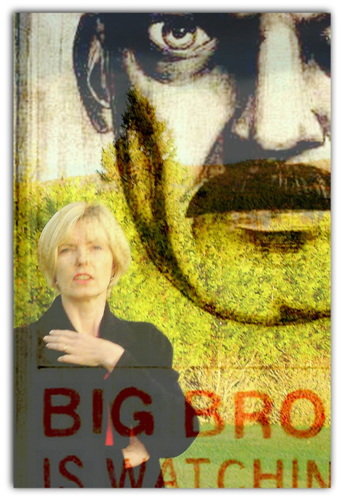
This document dates back to 2013 and describes initial stages of the process by which Big Brother crushes those who dare to dissent. First, Big Brother ensures that they lose sources of income. Then, if they persist in their dissent and happen to have real property, Big Brother takes their house. If this does not work, to silence them Big Brother takes what is left – their health – and they die. If you think this sounds farfetched and you find it hard to believe I suggest you also read these two documents:
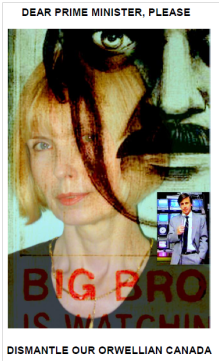
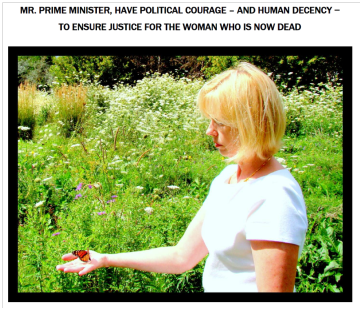
Big Brother is aware that History is a minefield that can blow overly inquisitive minds with revelations and uncomfortable truths. For this reason Big Brother prefers History to be the Entertainer rather than the Teacher. A symbol of sorts of the place history is accorded in the Orwellian Canada was the central event of Canada’s 150th birthday party in the nation’s capital in July 2017. One would think that such an important date would be a good opportunity to reflect on the country’s past and its lessons and to remind citizens about Canada’s successes and achievements of which Canadians should be rightfully proud. Instead, the birthday party’s organizers chose as the main event a show with a mechanical toy – Le Machine – brought to Ottawa from France:

The show was attended by tens of thousands of people, many of them newcomers to Canada, who must have enjoyed it but who learned nothing about this country’s history and its many world-class achievements in culture, science and sports over the course of 150 years.
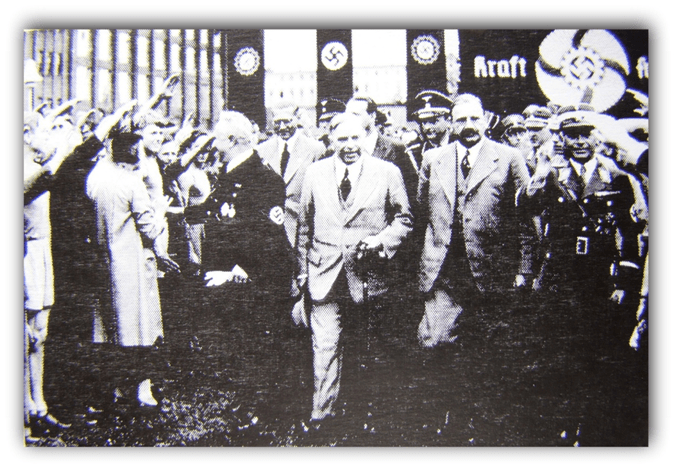
It is not surprising that few Canadians and even fewer newcomers to Canada know who the King’s Daughters were and what this picture’s Canadian connection is, − in the Orwellian Canada Historical Ignorance is Strength:

 OUR ORWELLIAN CANADA