ORWELLIAN CANADA & THE BELIEVERS:
WHEN ONE IS TOO MANY
“…Throughout recorded time, and probably since the end of the Neolithic Age, there have been three kinds of people in the world, the High, the Middle, and the Low… The aims of these three groups are entirely irreconcilable. The aim of the High is to remain where they are. The aim of the Middle is to change places with the High. The aim of the Low, when they have an aim – for it is an abiding characteristic of the Low that they are too much crushed by drudgery to be more than intermittently conscious of anything outside their daily lives – is to abolish all distinctions and create a society in which all men shall be equal…”
Book II, Chapter 9, The Theory and Practice
of Oligarchical Collectivism,
Chapter I, Ignorance is Strength,
Nineteen Eighty-Four
And then there were the Believers, − not necessarily religious believers but those who believed in certain principles and values that, in their opinion, were right and that were different from those preached by the High, the Middle and the Low. For this reason the Believers were outcasts and enjoyed neither their support, nor sympathy. Big Brother had no mercy for the Believers either, − they were a threat to his rule because they would not recognize the power of Money and one of the foundational principles of the Orwellian Canada: “Every person has his or her price.” Committed Believers were deemed to be unrepentant sinners and were erased. At best, their stories were incomplete or re-written, at worst – never told.
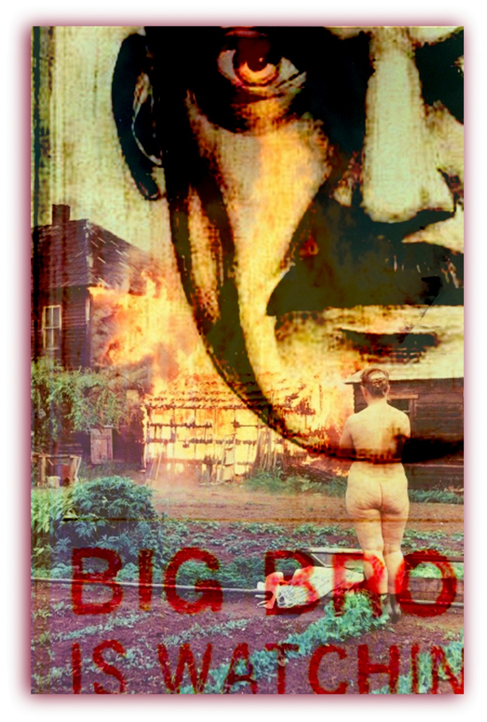
The picture collage above tells one such story that was published in the February – March 2013 issue of Canada’s History magazine that you can read here. This is the story of the Russian pheasants who were persecuted for their religious beliefs in the tsarist Russia and who moved to Canada in late 19th century only to discover that there was no escaping persecution there, too.
The reason was the same, − their values and beliefs. These dissident Russian pheasants – the Doukhobors, or Spirit Wrestlers − wanted to be neither the High and the Middle, nor the Low. They wanted to be themselves. They lived in agricultural communes and refused to exploit hired labour. They shared property equally among all members of the commune. They believed that life was not about accumulating personal wealth. They preached that personal needs should be limited by living a simple life, eating simple food and wearing simple clothes. They refused to serve in the army and rejected violence, − using modern day language they were peaceniks. In fact, the great Russian writer Leo Tolstoy who supported the Doukhobors and financed their resettlement to Canada in the late 1890s proposed in an open letter to a major Swedish newspaper to nominate the Doukhobors for the Nobel Peace Prize, writing that “… nobody else deserves more to be awarded the money that Nobel bequeathed to those who served the cause of peace.”
The Russian pheasants’ life philosophy was in more than one way akin to the philosophy that produced the counter-culture communes of mid-1960s, such as San-Francisco’s Haight-Ashbury and the East Village in New York, or the “three villages” of north-west London, − Notting Dale, Westbourne Park and Portobello. Their values were in tune with the Beatles’ famous business project of the time, − they became infected with the communal impulse and decided to set up the Apple Company that was described in the March 1968 issue of the International Times monthly as a “large company structure not geared to exploitation of men and making profit but to exploitation of ideas and sharing profits.”
Ironically, some of the values of the Russian pheasants that landed them in the early XX century in big trouble and in the Orwellian Canada fueled decades later the revolutions of the 1960s and 1970s in the West – the revolutions that gave the world the human rights, the women’s liberation and the environmental protection movements.
Initially, their life philosophy baffled and amused Big Brother. However, this changed when Big Brother realized that it ran counter to everything the Orwellian Canada stood for. Most importantly, it rejected the supremacy of Money. To destroy the followers of this philosophy Big Brother used the time-tested weapon of “divide and rule” by successfully planting seeds of division and rivalry in the agricultural communes and taking away the lands that were given to the newcomers, thus depriving them of the tool with which they were earning a living and supporting their families.
The Russian pheasants felt they were badly mistreated and deceived by the authorities. When they realized that justice was as elusive as the freedom to be what they were – the freedom they hoped to find in their new home country − in desperation the more radical of them, the so-called Freedomites, or Sons of Freedom, burned their houses. Some public schools and facilities built in their communes were also set on fire, and naked protests became yet another way to express their frustration and the tragedy of their situation:

Since women played a prominent role in such protests they were depicted accordingly in the media.
The story of these Russian pheasants reminds one of Aesop’s adage from The Four Oxen and the Lion: “United we stand, divided we fall.” The nearly 8000 Russian pheasants who settled in Saskatchewan in early XX century – a sizable group of immigrants by any measure who resettled to a country with a population of only 5 million at the time − were in the end assimilated almost without a trace.
The Russian pheasants were destined to wind up in the Orwellian Canada not only because their values proved to be incompatible with those shared by the majority around them, but also because they allowed to be divided.
A lot has been written about them. There is also a well-researched documentary by Jim Hamm Productions. If you are interested to explore the methods used by Big Brother to bring these Russian pheasants to heel you can start here. If you happen to know Russian you will benefit from the insights offered by a Russian professor and a Soviet diplomat. Keep your mind open when reading these and other materials about the Doukhobors, − remember what Benjamin Franklin wrote in Poor Richard’s Almanack: “Half a truth is often a great lie”…
There were other Believers in the Orwellian Canada, among them those who believed that “Freedom is the freedom to say that two plus two make four. If that is granted, all else follows”. (Book One, Chapter VII, Nineteen Eighty-Four). In the eyes of Big Brother the Believers who strived for this overarching freedom were particularly dangerous because they made it more difficult for Big Brother to fool all of the people all of the time.
She was one of these Believers. She created a space in the Orwellian Canada where she practiced her beliefs of love and care, the two of the many buildings blocks of the main freedom, − the freedom to say that two plus two make four. This is why Big Brother destroyed her creation.
She believed that people were born to fly, not to crawl. This is why among her best friends were butterflies, − she enjoyed the beauty of their flight and she helped those who could not fly.
This is why when Big Brother failed to make her crawl, he made her die. He was not quick on the trigger, − he knew that time was on his side, for nobody ever escaped from the Orwellian Canada. First, he made sure she was not able to earn a living. Then he took away her house and made her and her family homeless amidst a deadly heatwave. Then he took away her health. To make sure she got the message right he killed Dasha and Karina.
Although her story and the story of the dissident Russian pheasants were separated by almost a century, the method – persecution – was the same, as was the outcome…

Click here
 OUR ORWELLIAN CANADA